Understanding the Digital Marketing Ecosystem
Most businesses that struggle online aren't underfunded - they're fragmented. Their content team operates without knowing what the paid ads team is targeting. Their social presence has no connection to the topics their website ranks for. Each channel works in isolation, burning budget without compounding returns. The brands consistently winning online have figured out something their competitors haven't: the individual tactics of digital marketing only reach their full potential when they reinforce each other.
This is not a beginner's guide to buzzwords. It's a practical framework for understanding how SEO strategies, content marketing, social media marketing, and paid online advertising form an interconnected system - and how to build that system deliberately. Whether you're managing a team or running campaigns solo, what follows will give you the architecture to stop thinking in channels and start thinking in outcomes.
The following sections move from foundational principles through to execution and measurement, covering the strategic logic behind each channel, how they interact, and how to track whether your integrated approach is actually working. By the end, you'll have a clear picture of what a unified digital marketing strategy looks like in practice - not in theory.
The Core Pillars of Modern Digital Marketing
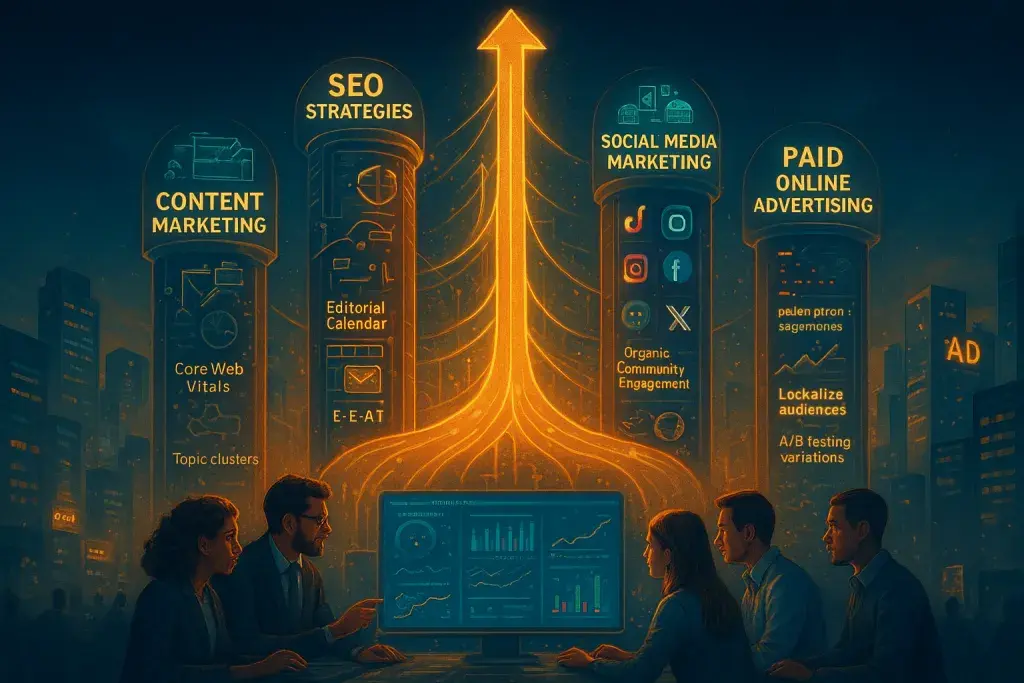
Digital marketing, at its structural core, rests on four interconnected pillars: organic visibility through SEO strategies, audience engagement through content marketing, community and awareness through social media marketing, and accelerated reach through paid online advertising. Each pillar has a distinct function, but none operates in a vacuum.
SEO strategies determine whether your website surfaces when people are actively looking for what you offer. Content marketing provides the substance that earns that visibility and builds trust over time. Social media marketing amplifies that content, builds community, and shortens the distance between brand and buyer. Paid online advertising fills the gaps - reaching people who haven't found you organically, accelerating results while longer-term strategies mature, and retargeting visitors who didn't convert the first time.
- SEO strategies - driving sustainable organic traffic through technical optimization, content relevance, and authority building
- Content marketing - creating valuable material that attracts, educates, and converts target audiences
- Social media marketing - building relationships, amplifying content, and maintaining visibility where audiences spend time
- Online advertising - paid placements across platforms that deliver targeted, measurable reach on demand
The mistake most marketers make is treating these as a menu - selecting two or three based on budget or preference. The reality is that each pillar strengthens the others. A well-optimized content piece fuels organic rankings and gives the social team something worth sharing. A successful social media campaign signals audience interest that can inform future content topics. Paid ads collect data on which messages convert, which then feeds back into organic content decisions.
Why Integration Beats Isolation
Running disconnected campaigns means paying for the same audience multiple times without building anything cumulative. A brand might spend significantly on paid social, generate traffic, and see conversions - but the moment the ads stop, so does the traffic. Nothing was built. No content library, no organic rankings, no community. The budget produced transactions, not growth.
Integrated digital marketing inverts this dynamic. A blog post optimized through solid SEO strategies attracts organic traffic for years. That post gets distributed through social media marketing channels, growing the audience. Some of that audience is retargeted with paid online advertising, pushing them toward conversion. The conversion data informs the next content marketing cycle. Each investment compounds on the last.
Think of it as infrastructure versus advertising. Advertising rents attention. Infrastructure owns it. An integrated strategy builds infrastructure through content and SEO while using paid channels to accelerate and test - not to substitute for organic growth entirely.
Setting the Right Goals Before You Start
Before executing any tactic, you need to define what success looks like and for whom. This sounds obvious, but most digital marketing failures trace back not to poor execution but to misaligned goals. A content marketing campaign optimized for brand awareness will look like a failure if leadership is measuring it against direct revenue. A social media marketing effort designed for community engagement will disappoint if the KPI is immediate lead volume.
Start by mapping your business goals to channel capabilities. Awareness goals suit social media marketing and content distribution well. Consideration goals respond to content depth and SEO strategies targeting mid-funnel keywords. Conversion goals align with online advertising, retargeting, and landing page optimization. Retention goals belong to email, community platforms, and consistent content marketing that keeps customers engaged after purchase.
Define audience personas before touching any platform. Know the specific problems your audience is trying to solve, the formats they prefer, and the platforms they trust. Every subsequent decision - what to write, where to post, how to target paid campaigns - flows from this foundation.
Building a Strong SEO Foundation
SEO strategies are often misunderstood as a technical afterthought - something you bolt onto content after it's written. In practice, they are the structural logic that determines whether everything else you produce ever gets found. Without a coherent approach to organic visibility, even excellent content marketing produces returns only for the brief window of active promotion.
Keyword Research as the Bridge Between SEO and Content
Keyword research is where SEO strategies and content marketing formally meet. It answers a simple but powerful question: what language does your audience use when looking for what you offer? The gap between the language your brand uses internally and the phrases your audience types when seeking solutions is often significant - and closing that gap is the first job of keyword research.
Effective research goes beyond high-volume terms. It maps intent. A keyword like "project management software" signals a different stage of interest than "project management software for remote teams under 50 people." The second phrase is lower in volume but far higher in specificity - and specificity correlates with conversion intent. Long-tail variations like these also face less competition, making them more accessible for brands that haven't yet built substantial domain authority.
Tools like Ahrefs, Semrush, and Moz provide data on search volume, keyword difficulty, and competitive landscape. But the strategic interpretation of that data - deciding which terms to pursue, which to assign to which content format, and how to build topic clusters - requires human judgment about your business priorities and competitive position.
On-Page SEO Best Practices
On-page optimization ensures that once you've identified the right topics, your pages are structured in a way that search engines can understand and users will engage with. This includes title tags that accurately reflect page content while incorporating primary keywords, meta descriptions that earn clicks rather than just describe content, and header structures that create logical hierarchies for both crawlers and readers.
Internal linking deserves more attention than it typically receives. Every link from one page to another passes authority and contextual relevance. A well-mapped internal linking structure distributes authority across your site, helps crawlers discover content, and guides users deeper into your content library - all of which serve both SEO strategies and content marketing goals simultaneously.
Image optimization, including descriptive file names and alt text, serves both accessibility and indexability. Page experience signals - how quickly a page loads, whether the layout shifts as it renders, how easily users interact with it - now factor directly into rankings. These are not minor technical details; they are table stakes for competitive digital marketing.
Technical SEO: The Infrastructure of Visibility
Technical performance is the foundation on which all other SEO strategies rest. A site that loads slowly, renders poorly on mobile, or contains pages that crawlers can't access will underperform regardless of content quality or link profile. Addressing technical issues isn't glamorous, but it's often the highest-leverage work available - especially for established sites that have accumulated structural debt over years of growth.
Core Web Vitals - a set of metrics measuring load time, visual stability, and interactivity - are now part of the ranking criteria used to evaluate page experience. Sites that consistently perform well on these metrics hold a measurable advantage. Mobile responsiveness is non-negotiable: the majority of web traffic worldwide now comes from mobile devices, and pages that don't render cleanly on small screens lose visitors before they've had a chance to engage with content.
Structured data markup helps search engines understand the semantic meaning of page content - whether it's an article, a product, a recipe, or an event. Implementing appropriate schema creates opportunities for enhanced search result appearances, which can meaningfully improve click-through rates without requiring higher rankings.
Off-Page SEO and Building Authority
Off-page authority - primarily built through backlinks from other credible websites - remains one of the most powerful signals in organic ranking algorithms. A link from an authoritative, topically relevant site acts as an endorsement, signaling that your content is worth referencing. Building this kind of authority takes time, but the cumulative effect is a more resilient organic presence that holds rankings under competitive pressure.
The most durable link-building approaches are those that earn links rather than manufacture them: creating genuinely useful resources, publishing original research, producing content that journalists and bloggers want to cite, and building relationships within your industry's online community. These methods align link building with content marketing goals, making both efforts more efficient.
Social media marketing contributes to off-page authority indirectly. Content that circulates widely on social platforms reaches more people who might link to it. Consistent brand visibility builds the kind of recognition that drives branded searches - and branded search activity is itself a signal of authority and relevance.
Crafting a Content Marketing Strategy That Converts
Content marketing is frequently mistaken for blogging. In reality, it's a systematic approach to creating and distributing material that moves specific audiences through specific stages of a decision process. The output might be blog posts, videos, podcasts, case studies, or interactive tools - the format is secondary to the strategic purpose the content serves.
Developing a Content Strategy Aligned With Business Goals
A content strategy without a clear connection to business goals is a publishing schedule, not a marketing asset. Every piece of content should serve a defined purpose: attracting new audiences at the awareness stage, helping potential buyers evaluate options at the consideration stage, or resolving final objections at the decision stage. Producing content without mapping it to this funnel logic means creating material that may be interesting but doesn't advance your commercial objectives.
Audience personas are the starting point. They define whose problems you're solving, what language resonates with them, which platforms they inhabit, and what questions they're asking at different stages of their journey. Marketers who want to scale their content distribution efficiently - and those exploring how to source the digital accounts and platform access needed to manage multi-channel presence - often turn to services like accmarket, which provides access to social and digital platform accounts that support broader campaign infrastructure. Understanding your audience at a granular level is what transforms generic content production into a strategically targeted content marketing operation.
An editorial calendar operationalizes the strategy. It maps content topics to audience segments, assigns formats, schedules publication, and coordinates distribution across channels. Done well, it ensures that content marketing efforts stay focused on priority topics rather than drifting toward whatever seems interesting in the moment. It also enables coordination between the content team and paid advertising - so that high-performing organic content can be amplified with budget at the right time.
Creating High-Quality, SEO-Optimized Content
Content that ranks and content that converts share a common quality: specificity. Vague, high-level material that covers a topic without depth satisfies neither users nor ranking algorithms. What earns both visibility and engagement is content that demonstrates genuine expertise, addresses real questions thoroughly, and provides actionable guidance users can apply directly.
The concept of topic clusters has largely replaced the old model of targeting individual keywords in isolation. A pillar page covers a broad topic comprehensively - serving as the authoritative hub. Cluster pages explore specific subtopics in depth, linking back to the pillar. This architecture sends strong relevance signals about the site's authority on a given subject and improves the overall performance of SEO strategies across the cluster.
The E-E-A-T framework - Experience, Expertise, Authoritativeness, Trustworthiness - reflects what high-quality content marketing actually looks like in practice. First-hand experience with the subject matter, accurate information, credentials or demonstrated authority, and transparent sourcing are not just quality guidelines; they're the characteristics that distinguish content that builds lasting trust from content that fills space.
Content Distribution: Getting Your Content Seen
Creating content without a distribution plan is like publishing a book and leaving it in a warehouse. The distribution phase of content marketing is where most strategies underinvest - assuming that publishing is the endpoint rather than the beginning. In reality, the work of getting content in front of the right people is equal in importance to creating it.
Distribution operates across owned, earned, and paid channels. Owned channels include email newsletters, social media profiles, and the website itself. Earned distribution comes from shares, backlinks, press coverage, and community engagement - outcomes that strong content earns over time. Paid distribution uses online advertising to put content directly in front of targeted segments who haven't found it organically.
Social media marketing is one of the most immediate distribution channels available. Sharing content across relevant platforms - formatted appropriately for each one - extends its reach and drives referral traffic that reinforces organic performance. When a piece of content gains significant social traction, it often earns links and branded searches that further strengthen its SEO standing.
Measuring Content Performance and Iterating
Content marketing produces results that compound over time, which makes attribution more complex than paid advertising. A blog post published today might generate its most significant organic traffic eighteen months from now. This timeline requires patience and a measurement framework designed for long-term value, not just immediate returns.
The metrics that matter most depend on the content's purpose. Awareness-stage content should be measured by reach, impressions, and new visitor acquisition. Consideration-stage content performs best when measured against engagement metrics - time on page, scroll depth, return visits, and email sign-ups. Decision-stage content should be evaluated on lead generation, conversion rate, and assisted revenue.
Regular content audits - reviewing existing pieces for accuracy, performance, and optimization opportunities - consistently yield better returns than simply producing more new content. Updating a well-ranked post with fresh information and improved structure can restore and exceed its original traffic levels, compounding the original investment rather than starting from zero.
Leveraging Social Media Marketing for Brand Growth
Social media marketing sits at an interesting intersection of content distribution, community building, customer service, and paid advertising. Its organic reach has narrowed significantly on most major platforms over the past decade, but its role in building brand familiarity, maintaining visibility, and creating genuine community remains irreplaceable for brands that approach it strategically rather than reactively.
Choosing the Right Platforms for Your Audience
Platform selection is one of the most consequential early decisions in a social media marketing strategy - and one of the most commonly mishandled. The instinct is often to maintain a presence everywhere, which typically results in thin, undifferentiated content across multiple channels, none of which builds meaningful traction.
A more effective approach is to evaluate each platform against two criteria: where your specific audience is most actively engaged, and where the content formats that suit your brand perform best. A B2B technology company's audience is more concentrated and more commercially receptive on LinkedIn than on Instagram. A fashion brand targeting younger consumers will find more engagement on platforms built around visual and short-form video content. Concentration of effort on two or three well-chosen platforms outperforms a dispersed presence across six.
- LinkedIn - strongest for B2B audiences, professional services, thought leadership, and recruiting content
- Instagram - visual brands, lifestyle products, consumer goods, and audiences under 40
- TikTok - short-form video, younger demographics, entertainment-forward content with high organic reach potential
- Facebook - broad demographic reach, local businesses, community groups, and paid advertising infrastructure
- X (formerly Twitter) - real-time conversation, media, technology, and current events-adjacent brands
Organic Social Media Strategy: Building Community and Trust
Organic social media marketing is not primarily about reach - it's about relationship depth. The brands that perform consistently well on social platforms are those that treat their audience as a community rather than a broadcast list. This means responding to comments, participating in industry conversations, showing the human side of the brand, and sharing content that serves the audience's interests rather than just promoting the brand's products.
Consistency in posting frequency, visual identity, and brand voice builds the familiarity that makes audiences more receptive to commercial messages. A brand that publishes useful, engaging content regularly earns the right to occasionally promote - whereas a brand that only posts when it has something to sell quickly loses audience attention.
Content formats that perform well organically tend to share certain characteristics: they're specific rather than generic, they provoke a clear emotional or intellectual response, and they invite engagement. Questions, bold statements, behind-the-scenes content, and practical advice consistently outperform polished promotional posts in organic social contexts.
Using Social Signals to Support SEO
The relationship between social media marketing and organic rankings is indirect but real. Social platforms don't directly determine rankings, but activity on those platforms produces outcomes that do. Content that circulates widely on social media reaches more people who might link to it from their own websites, increasing the backlink profile that strengthens organic authority. Social sharing also drives referral traffic, which produces behavioral signals - time on site, pages per session, return visits - that indicate content quality.
Brand mentions and branded searches are another mechanism. A brand with consistent social media visibility generates more branded queries, which reinforces the perception of authority and relevance. When people know your brand well enough to search for it directly, that signal contributes positively to how your domain is evaluated in the broader competitive landscape.
Social Media Analytics and Performance Tracking
Social media marketing measurement has matured considerably, but it still requires careful interpretation. Vanity metrics - follower counts, raw likes - tell you little about business impact. The metrics worth tracking are those tied to actual audience behavior and commercial outcomes: engagement rate relative to reach, click-through rates to owned properties, conversion rates from social referral traffic, and customer acquisition cost for paid social campaigns.
Each major platform provides native analytics that track these metrics at varying levels of depth. Connecting social data to your broader analytics infrastructure - through UTM parameters and a centralized reporting tool - gives you a cross-channel view that reveals how social media marketing contributes to the full customer journey, not just isolated interactions.
Mastering Online Advertising and Paid Campaigns
Paid online advertising is frequently treated as a shortcut - a way to generate immediate results while organic channels catch up. That framing undersells it. At its best, online advertising is a precision targeting instrument that reaches specific audiences with specific messages at specific moments in their decision process. It's fast, measurable, and infinitely testable. It's also expensive to run poorly.
Understanding the Paid Advertising Landscape
The paid digital advertising landscape spans several distinct categories, each suited to different objectives and audience states. Pay-per-click advertising on intent-driven platforms captures audiences who are actively looking for a solution - high commercial intent, high relevance, higher cost per click. Display advertising places visual ads across a network of websites, suited to awareness and retargeting. Paid social media advertising places sponsored content within platform feeds, combining targeting precision with the native engagement dynamics of social environments.
- Paid search - captures high-intent audiences actively seeking specific solutions; works in direct complement to organic SEO strategies
- Paid social - reaches targeted demographics based on interests, behaviors, and connections within social platforms
- Display advertising - broad visual reach across publisher networks; effective for awareness and retargeting
- Programmatic advertising - automated, data-driven ad placement across digital inventory in real time
- Video advertising - pre-roll and in-stream formats on video platforms; strong for brand storytelling and upper-funnel awareness
Platform selection for online advertising follows the same audience-first logic as organic social media marketing. The most relevant platform is the one where your audience is most receptive - and that depends on where they are in their decision journey, not just where they spend time.
Creating High-Converting Ad Creatives and Copy
Most paid advertising fails not because of poor targeting but because of weak creative. An ad that reaches exactly the right person at exactly the right moment will still fail if the message doesn't resonate or the offer isn't compelling. Creative quality - the combination of visual design, headline, body copy, and call to action - is the variable that most directly controls whether an impression becomes a click and a click becomes a conversion.
Effective ad copy is specific, not generic. It names the audience's problem, articulates a concrete outcome, and removes uncertainty about what happens next. Headlines that make a specific promise consistently outperform those that make a vague one. Calls to action that describe a concrete next step ("Download the guide," "See pricing") outperform generic prompts ("Learn more").
A/B testing is the mechanism that separates improving campaigns from stagnating ones. Testing one variable at a time - headline versus headline, image versus image, offer versus offer - generates clean data about what actually works with your specific audience. The insights from paid campaign testing often have direct applications to organic content marketing, since they reveal what language and offers drive action.
Retargeting and Audience Segmentation
Retargeting - showing ads specifically to people who have previously visited your site or engaged with your content - consistently delivers stronger performance than cold audience advertising, because it focuses budget on people who have already demonstrated relevant interest. A visitor who spent time on your pricing page and didn't convert is a fundamentally different audience than someone who has never heard of your brand.
Audience segmentation takes this logic further. Rather than treating all website visitors as a single group, segmented retargeting delivers different messages to different visitor types based on what they engaged with. Product page visitors might see social proof and reviews. Blog readers might see an offer to download a more comprehensive resource. Cart abandoners might see the specific product they left behind, paired with a time-limited incentive.
Lookalike audiences extend the efficiency of well-performing customer segments by finding new prospects who share behavioral and demographic characteristics with your existing best customers. This is particularly powerful in paid social environments, where platform data enables remarkably precise audience modeling.
Budgeting, Bidding, and Scaling Paid Campaigns
Budget allocation in online advertising should follow performance data, not assumptions. Starting campaigns with smaller test budgets across multiple ad sets generates the data needed to identify which combinations of audience, creative, and offer perform. Scaling comes after validation - not before it. Campaigns scaled prematurely on insufficient data frequently hit diminishing returns or miss audience saturation signals until significant spend has been wasted.
Bidding strategy selection depends on campaign objective. Awareness campaigns typically work well with CPM (cost per thousand impressions) bidding. Direct response campaigns - where you're optimizing for a specific conversion - often perform better under CPA (cost per acquisition) or target ROAS (return on ad spend) bidding once there's sufficient conversion data to train optimization algorithms.
The decision to scale a campaign should be based on stable ROAS above your target threshold, controlled cost per acquisition, and audience headroom - meaning there's still enough of the target audience to reach without aggressive frequency that creates ad fatigue. When these conditions are met, incremental budget increases of 20-30% every few days, rather than sudden large increases, typically preserve performance more reliably.
Integrating All Channels Into a Unified Digital Marketing Strategy
The difference between a collection of digital marketing tactics and a genuine strategy is coherence. Coherence means that every channel is working toward the same audience, the same message hierarchy, and the same commercial goals - and that the data flowing from each channel informs decisions in the others. Building this coherence is harder than executing any individual tactic, but it's the source of the compounding returns that separate high-performing digital programs from average ones.
Building a Unified Content and Campaign Calendar
A unified calendar is the operational tool that makes integration practical. It maps every content publication, social post, email send, and paid campaign launch onto a shared timeline - making dependencies visible and enabling coordination that would be impossible if each team maintained separate schedules.
The most effective calendars are organized around themes or audience priorities rather than just publication dates. If a major product launch is planned for a specific month, the content marketing team publishes supporting blog content in the weeks prior, the social media marketing team begins seeding related conversations, and the paid advertising team prepares retargeting audiences from the organic content traffic. Each element feeds the next.
This kind of coordination also prevents the common problem of publishing great organic content that receives no amplification - or running paid campaigns to audiences who haven't been warmed up by any prior content exposure. The calendar makes these gaps visible before they become expensive.
Cross-Channel Tracking and Attribution
Understanding which channels are contributing to conversions - and how - is one of the most technically challenging aspects of integrated digital marketing. Most customers encounter a brand multiple times across multiple channels before making a purchase. A visitor might first find a blog post organically, return after seeing a social post, and convert after clicking a retargeting ad. Simple last-click attribution would credit only the retargeting ad, making the content marketing and social media marketing that preceded it appear to have no value.
Multi-touch attribution models distribute credit across the full conversion path, providing a more accurate picture of each channel's contribution. Implementing UTM parameters consistently across all links - in social posts, email campaigns, and paid ads - ensures that traffic sources are trackable through your analytics platform. This data is essential for making informed decisions about where to allocate budget and where to intensify or reduce investment.
Cross-channel reporting that consolidates data from organic analytics, paid advertising platforms, and social media analytics into a single view enables the kind of strategic analysis that siloed reporting can never support. Tools like Google's Looker Studio or dedicated marketing analytics platforms make this consolidation achievable without requiring custom data engineering.
Tools and Technology for Integrated Marketing
The technology stack for integrated digital marketing doesn't need to be complex, but it does need to be connected. At minimum, a functioning integrated stack requires analytics infrastructure that captures traffic and conversion data from all channels, a content management system with strong SEO tooling, a social media management platform, and advertising accounts on the relevant paid channels.
- Analytics - GA4 or equivalent for unified web and conversion tracking across all traffic sources
- SEO tooling - platforms like Ahrefs or Semrush for keyword research, site auditing, and competitive analysis
- Content management - a CMS with structured content capabilities and clean URL architecture
- Social media management - tools like Hootsuite or Buffer for scheduling, publishing, and cross-platform analytics
- Marketing automation - platforms like HubSpot or ActiveCampaign for email, lead nurturing, and CRM integration
- Paid advertising - native ad managers on the relevant platforms, with conversion tracking properly configured
The value of these tools comes not from having them but from integrating them - ensuring data flows between systems so that a lead captured through content marketing becomes a retargeting audience for online advertising, and a high-performing paid audience informs future content marketing targeting decisions.
Measuring Success and Continuously Optimizing Your Strategy
A digital marketing strategy that isn't measured isn't managed. But measurement without interpretation is just data collection. The goal of performance tracking is to generate actionable insights - specific, concrete changes to make based on what the numbers reveal. This requires a measurement framework that's tied to business goals, not just channel-level metrics.
Key Performance Indicators by Channel
Each channel in an integrated digital marketing program has its own relevant performance metrics. The discipline is knowing which metrics matter for which objectives - and not letting high performance on an irrelevant metric distract from what the channel is actually supposed to achieve.
- SEO strategies - organic traffic volume, keyword ranking positions, pages with top-10 visibility, organic conversion rate, backlink acquisition rate
- Content marketing - new organic sessions from content, average engagement time, content-assisted conversions, lead generation volume from content offers
- Social media marketing - engagement rate per post, referral traffic from social, follower growth rate, share of voice in relevant conversations
- Online advertising - cost per acquisition (CPA), return on ad spend (ROAS), click-through rate (CTR), conversion rate by audience segment
These metrics don't exist in isolation. Organic traffic growth reduces the volume of paid traffic you need to buy. Strong content marketing performance lowers the cost per lead from paid campaigns by warming audiences before they encounter ads. Social media engagement data tells you which messages resonate before you invest in amplifying them with paid budget.
Conducting Regular Audits Across All Channels
Audits are the mechanism for catching strategic drift before it becomes expensive. Without regular review, campaigns continue running on outdated targeting, content sits on the site without being updated, and the overall digital marketing strategy gradually loses alignment with current business priorities and market conditions.
A comprehensive content audit reviews existing pages for accuracy, current relevance, SEO performance, and conversion contribution. Pages that once ranked well but have declined may need updated information, improved structure, or new internal links. Pages that were never published at the right stage of the content funnel might need to be repositioned or consolidated with stronger related content.
Paid advertising audits should examine audience fatigue (declining CTR on previously performing ads), budget efficiency across campaigns, landing page conversion rates, and offer relevance. Social media audits should review what content formats and topics are generating genuine engagement versus posts that receive little response despite consistent effort. The aggregate findings from these audits should feed directly back into the editorial calendar and campaign planning cycle.
Adapting to Algorithm Changes and Market Shifts
Any digital marketing strategy built on tactics rather than principles becomes fragile in the face of change. Platform algorithms shift. Paid advertising costs fluctuate. Audience preferences evolve. The brands that maintain strong performance through these changes do so not because they anticipated every update, but because they built strategies that are diversified across channels and grounded in genuine audience value.
Diversification is the structural hedge against single-channel dependency. A brand that derives 80% of its traffic from one organic keyword cluster is genuinely vulnerable to ranking changes. A brand whose audience is spread across organic traffic, email, social media marketing, and paid channels has multiple paths to reach its customers even if one channel is disrupted.
Staying current with platform changes requires active monitoring of industry news, participation in professional communities, and a willingness to test new formats and features as they emerge. The brands that benefit most from social platform algorithm changes are typically those already producing the kind of content the algorithm rewards - genuine engagement, relevant content, and consistent posting. The update confirms their existing approach rather than forcing a pivot.
Frequently Asked Questions
How much of a digital marketing budget should go to paid advertising versus organic channels?
There's no universal ratio, but a common starting framework allocates roughly 40-60% of the marketing budget to paid channels in the early stages of a business, when organic authority is still building and speed to market matters. As content marketing and SEO strategies mature and organic traffic grows, that balance can shift - with more investment flowing to content production and less required in paid acquisition to maintain the same volume. The right split is the one that produces the lowest blended customer acquisition cost across all channels.
Can a small team realistically execute an integrated digital marketing strategy?
Yes, but it requires prioritization rather than full channel coverage from the start. A team of two or three people should focus on one or two organic channels - typically content marketing paired with SEO strategies - and one paid channel, rather than attempting to maintain active presence across everything simultaneously. Depth on fewer channels produces better results than shallow execution across many. Tools that consolidate scheduling, reporting, and optimization reduce the operational burden significantly.
How do I know which content topics will actually drive business results?
Work backward from your customers' decision process. What questions do they ask before buying? What problems do they need to solve that your product or service addresses? Interview existing customers, review sales call recordings, and analyze the search terms that currently bring converting traffic to your site. Content mapped to these specific questions at specific decision stages will drive commercial results - content produced based on what seems interesting or timely without this mapping will not.
Why do my paid ads perform well initially but decline after a few weeks?
This is audience fatigue - the same people seeing the same creative repeatedly until they stop responding. It's normal and predictable. The solution is creative rotation: introducing new ad variations before performance deteriorates rather than after. Monitoring frequency (average number of times each person has seen your ad) is the early warning indicator. When frequency climbs above roughly three to four impressions per week for a given audience, refreshing creative or expanding the target audience will restore performance.
Is social media marketing worth the effort if my organic reach keeps declining?
Organic reach on most mature social platforms has decreased, but this doesn't mean social media marketing has lost its value. Community building, brand familiarity, customer service, and content distribution still happen effectively through social channels - they just require more intentional content and, often, modest paid amplification of the strongest organic posts. Treating social as a free broadcast channel produces disappointing results. Treating it as a relationship infrastructure with selective paid support produces consistent returns.
How long before an integrated digital marketing strategy produces measurable results?
Paid campaigns can produce measurable results within days. Content marketing and SEO strategies typically require three to six months before showing significant organic traction, and twelve months or more to reach their full compound effect. The practical implication is that paid channels should carry more weight on short-term revenue goals while organic channels are being built - not because organic is less valuable, but because it operates on a different timeline. Brands that abandon organic investment because it hasn't paid off in 90 days typically do so just as results are beginning to accumulate.