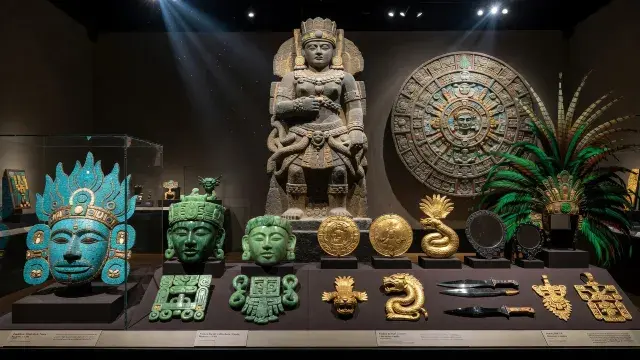
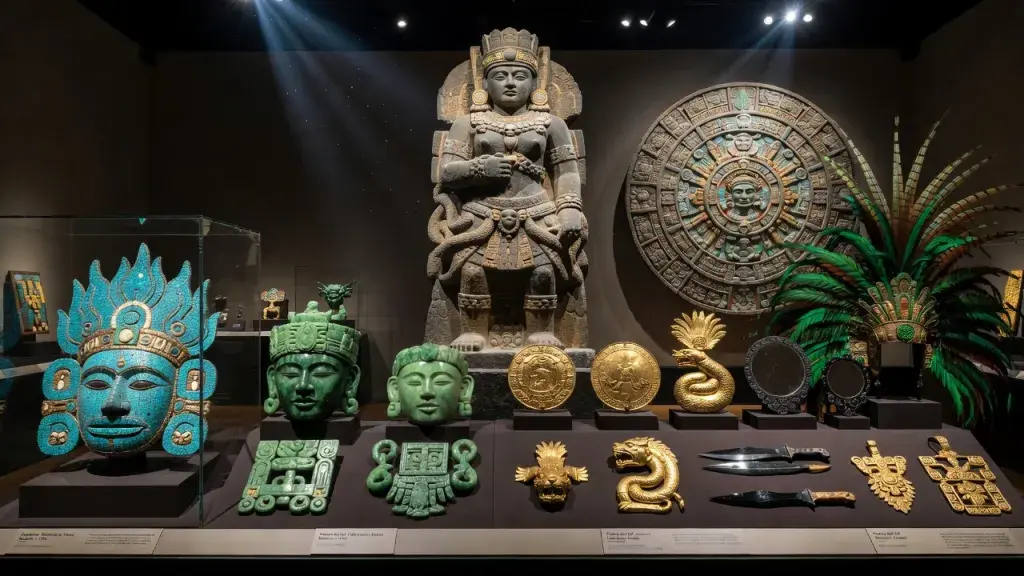
Spanish conquistadors who entered Tenochtitlan in 1519 described a city larger and cleaner than Madrid, with markets that moved more goods in a single day than most European cities saw in a month. That single observation, recorded by soldiers who had every reason to exaggerate their own conquest, still tells us something reliable: the Aztec empire was not a scattered collection of tribes but a highly organized civilization with sophisticated craft production, extensive trade networks, and an appetite for beauty that rivaled anything in contemporary Europe. What survives of that world - the melted gold, the carved stone, the feathered regalia lost to time and humidity - forms a fragmented but revealing record.
Understanding Aztec treasures means confronting an uncomfortable irony. Most of the empire's finest goldwork no longer exists; it was melted into ingots by Spanish colonizers within years of the conquest. What remains comes largely from other categories of material culture - stone sculpture, ceramics, codices, and the rare buried offering that escaped looting. Anyone curious enough to look past the history books will find that even entertainment products now reference this legacy, and a modern slot game called treasures of aztec features borrows directly from the imagery of jaguars, serpents, and gold discs that defined Aztec visual culture. That borrowing, however playful, points to a genuine hunger for connection with a civilization whose physical remains are frustratingly incomplete.
This piece works through what actually survives, how it was made, what it meant to the people who made it, and why so little Mesoamerican gold exists today compared to other ancient cultures. It also addresses the practical questions collectors, students, and travelers frequently raise about authenticity, museums, and ongoing archaeological work.
The Aztec Worldview Behind the Artifacts
Aztec material culture cannot be separated from Aztec cosmology. Nearly every object of value - from a carved obsidian mirror to a turquoise mosaic mask - served a religious or political function before it served an aesthetic one. Understanding that context changes how a modern viewer should read these pieces.
Religion as the Organizing Principle
The Aztec pantheon governed agriculture, warfare, and the calendar simultaneously, which meant that craft production was rarely a purely decorative exercise. A gold pendant shaped like Xiuhtecuhtli, the fire god, was not jewelry in the modern sense; it was a functional object meant to channel divine favor. This is a defining trait among Aztec features - objects were designed to work, not just to be admired.
Tribute, Power, and Material Wealth
The Aztec state extracted tribute from conquered provinces in the form of raw materials: gold dust, jade, cacao, feathers, and cotton. This tribute system, documented in surviving codices like the Codex Mendoza, explains why the imperial capital accumulated such density of fine craftsmanship. Materials flowed inward, and skilled artisans in Tenochtitlan transformed them into objects that reinforced the emperor's authority.
Calendar and Cosmic Order in Design
Many surviving pieces, including the famous Aztec Sun Stone, encode calendrical and cosmological information rather than purely decorative patterns. Reading these objects requires understanding the 260-day ritual calendar and the 365-day solar calendar that structured Aztec life.
Aztec Treasures: Materials, Meaning, and Loss
The phrase "Aztec treasures" conjures images of glittering gold hoards, but the reality is more layered and, in some ways, more interesting than the myth.
Why So Little Gold Survives
Spanish accounts describe rooms filled with golden objects in Moctezuma's palace. Almost none of that gold exists today in its original form. Colonial administrators systematically melted looted pieces into transportable bars, erasing centuries of craftsmanship for the sake of efficient shipping. This is the central tragedy behind the study of Mesoamerican gold: the objects themselves rarely survive, only descriptions of them.
Jade, Turquoise, and the True Aztec Hierarchy of Value
Contrary to European assumptions, the Aztecs did not consider gold their most precious material. Jade held higher symbolic status, associated with water, fertility, and life itself. Turquoise mosaics, often applied to wooden or bone masks, carried similarly elevated status and were reserved for rulers and high priests.
- Jade - linked to water, breath, and the heart; used in burial masks and royal ornaments
- Turquoise - imported from what is now the southwestern United States, used in mosaic work
- Gold - valued for its association with the sun and for its workability into ornaments and tribute items
- Feathers, especially quetzal plumes - arguably rarer and more prestigious than any mineral
Surviving Examples in Major Collections
The few gold pieces that escaped melting, along with reconstructions based on documentary evidence, are held today in institutions such as the Museo Nacional de Antropología in Mexico City and the Museum für Völkerkunde in Vienna, which holds objects believed to have been part of Moctezuma's gifts to Hernán Cortés. These fragments give researchers rare direct evidence of goldsmithing techniques described in colonial texts but rarely visible in physical form.
Ancient Aztec Artifacts and What They Reveal
Beyond precious metals, the broader category of ancient Aztec artifacts includes stonework, ceramics, textiles, and codices, each offering a different window into daily and ceremonial life.
Stone Sculpture and Monumental Carving
The Coatlicue statue and the Sun Stone represent the pinnacle of Aztec stone carving, combining technical mastery with dense religious symbolism. Unlike gold, stone survived colonial melting campaigns, which is why so much of what we know about Aztec iconography comes from carved basalt and andesite rather than metalwork.
Everyday Objects: Tools, Pottery, and Obsidian
Obsidian blades, used for everything from shaving to human sacrifice, appear in enormous quantities at archaeological sites. Their abundance tells archaeologists about trade routes, since obsidian sources were limited to specific volcanic regions and required extensive exchange networks to reach Tenochtitlan.
Codices as Artifacts of Knowledge
Painted books recording history, tribute records, and religious practice count among the most informative ancient Aztec artifacts, even though few pre-conquest originals survived Spanish burning campaigns. The Codex Borbonicus and later colonial-era copies remain essential sources for reconstructing Aztec administrative and ritual life.
Pre-Columbian Relics Across Mesoamerica
Placing Aztec material culture within the wider Mesoamerican context clarifies what was distinctly Aztec versus what was inherited from earlier civilizations.
Shared Traditions with the Maya and Olmec
Jade working, the ballgame, and calendrical systems all predate the Aztecs by centuries, originating with the Olmec and refined by the Maya. Aztec artisans adapted these traditions rather than inventing them outright, which is why pre-Columbian relics from different regions often share stylistic and symbolic vocabulary.
Regional Variation in Craft Techniques
Mixtec goldsmiths, absorbed into the Aztec tribute system after conquest, produced some of the finest metalwork attributed to the empire. Much of what colonial sources describe as "Aztec gold" was actually crafted by Mixtec artisans working under Aztec political authority, a distinction often lost in popular retellings.
Archaeological Sites Beyond Tenochtitlan
Sites like Tlatelolco and Texcoco continue to yield relics that refine scholarly understanding of urban life outside the imperial core, showing that artistic production was not confined to the capital alone.
How Aztec Features Shaped Artistic Identity
Certain visual and structural traits recur across Aztec objects regardless of material, forming a recognizable artistic signature.
Symbolism of Animals and Deities
Jaguars, eagles, and serpents appear constantly, each tied to specific military orders or deities. The eagle warrior and jaguar warrior societies, for instance, used these animal identities in both ceremonial dress and permanent artwork.
Geometric Precision and Repetition
Aztec design favored disciplined geometric patterning over the more organic curves seen in some earlier Mesoamerican styles, reflecting a broader cultural emphasis on order and cosmic structure.
Function Over Pure Decoration
Nearly every recognizable Aztec feature - from the stepped pyramid silhouette to the sunburst motif - carried functional, calendrical, or religious weight rather than existing purely as ornament.
Modern Discovery, Preservation, and Ethical Questions
Archaeological work on Aztec sites continues actively, particularly beneath modern Mexico City, where construction projects regularly expose new layers of the ancient capital.
The Templo Mayor Excavations
Ongoing excavation of the Templo Mayor, discovered accidentally by electrical workers in 1978, has produced thousands of offerings, including greenstone figures, sacrificial knives, and shell ornaments buried in ritual deposits.
Repatriation and Museum Ethics
Mexico has pushed for the return of artifacts held in foreign museums and private collections, arguing that pieces removed during and after the conquest belong in their country of origin. This debate intersects with broader international discussions about colonial-era acquisitions.
The Antiquities Market and Forgery Risks
The market for pre-Columbian relics remains active and, unfortunately, riddled with forgeries. Buyers without expert verification frequently acquire modern reproductions sold as authentic, which is why reputable provenance documentation matters more than visual appeal alone.
Questions?
Ask something specific here.
Frequently Asked Questions
Why is there so little surviving Aztec gold compared to stone artifacts?
Spanish colonizers melted most captured gold objects into transportable ingots almost immediately after the conquest, prioritizing shipment value over cultural preservation. Stone survived because it had no melt value, which is why museums display far more Aztec sculpture than metalwork.
What makes an artifact authentically Aztec rather than from another Mesoamerican culture?
Authentication relies on stylistic analysis, material sourcing, and archaeological context rather than appearance alone. Genuine Aztec pieces typically show specific iconographic markers tied to the imperial pantheon and were often produced or commissioned within the Basin of Mexico.
Where can I see genuine Aztec artifacts today?
The Museo Nacional de Antropología in Mexico City holds the largest and most significant collection, including material from the Templo Mayor excavations. Smaller but notable holdings exist in European institutions that received pieces during and after the colonial period.
Is it legal to own pre-Columbian relics as a private collector?
Ownership laws vary significantly by country, and Mexico strictly regulates the export of archaeological material, treating most pre-Columbian objects as national patrimony. Buyers should verify legal export documentation before any purchase, since undocumented pieces may have left the country illegally regardless of how they are marketed.
How do archaeologists date Aztec artifacts without written records?
Stratigraphic context, radiocarbon dating of organic material found alongside objects, and stylistic comparison with securely dated pieces all contribute to dating. Codices and Spanish colonial accounts also provide cross-referencing points for events tied to specific artifacts.
Did the Aztecs value gold more than jade or turquoise?
No. Jade and turquoise held higher symbolic status in Aztec culture, associated with water, fertility, and elite identity. Gold was prized primarily for its solar symbolism and workability, but Spanish assumptions about gold's supreme value did not match Aztec priorities.